SINCE 2014
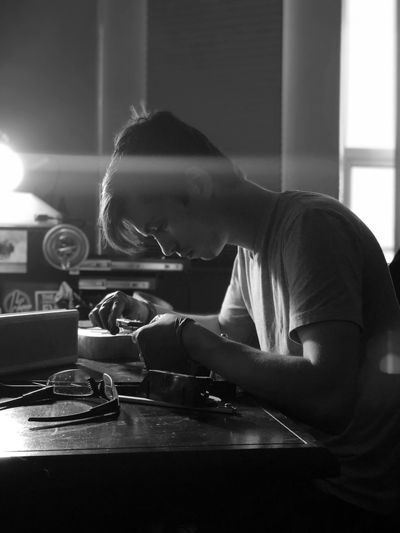
I am Brett Bailey — guitarist, luthier, designer, and the founder of Contriver Guitars.
For over twenty years, I’ve immersed myself in the instrument from every possible angle: as a player, builder, machinist, and designer. Long before building guitars professionally, I spent countless hours each day refining my technique, writing progressive metal, and obsessively studying tone, construction, and the subtle physical differences between instruments from builders around the world.
That obsession eventually became a profession.
After studying at the Canadian School of Lutherie and Mohawk College for AutoCAD and 3D modelling, I began pursuing guitar building with a focus that extended far beyond traditional craftsmanship alone. Years spent working as an independent repair technician, alongside time at Exotic Woods and four years building at F Bass, gave me an unusually deep understanding of materials, manufacturing, structural behaviour, and the realities of producing high-performance instruments at a professional level.
Working closely with exotic hardwoods taught me the nuances of grain structure, density, elasticity, oil content, and stiffness. Building professionally alongside highly respected luthiers reinforced the importance of precision, consistency, and relentless attention to detail. At the same time, extensive work in CAD, CAM, CNC machining, and surface modelling pushed my approach beyond conventional lutherie and into engineering-driven design.
This eventually led to the development of what I call Computational Lutherie — a discipline in which mathematical relationships, parametric systems, and physical modelling govern decisions of form, proportion, and structure, replacing intuition and tradition as the primary design drivers.
Every instrument I design — including the Signature, Echo, Plunk Bass, Foundation, Refraction, and Concision Series — is developed entirely in Autodesk Fusion through parametric and timeline-based workflows, advanced NURBS topology, Class-A T-Spline surfacing, CAM integration, and CNC manufacturing.
The instrument is treated as a managed energy system.
Mass distribution, stiffness continuity, load paths, compliance relief, and vibrational behaviour are considered as interconnected variables that directly influence how energy moves through the structure. That framework informs every decision — from geometry and material selection to machining strategy and final voicing.
Today, alongside building instruments under Contriver Guitars, I also work as a contracted Autodesk Fusion CAD/CAM specialist, helping other builders develop machines, workflows, and geometric systems for manufacturing.
My goal has always been to understand why they work — and then push the instrument further.
Play with ingenuity.
Play Contriver.